Showing posts with label Harte Recordings. Show all posts

Thursday, December 17, 2009

The Road To Haiti by Gage Averill

Gage Averill is a professor of history and culture at the University Of Toronto. He is the premier scholar on Haiti and the person responsible for curating the ALAN LOMAX IN HAITI music portion of the ALAN LOMAX IN HAITI boxset, writing the notes, and translating many of the songs. He will be talking on FORUM this morning, KQED radio, at 10 am PST....

David Katznelson, our producer, asked how I got involved in Haiti; probably the question I’ve been asked most over the last twenty plus years. After working for some years as a tenant organizer in low income housing projects and then driving a tractor for an apple orchard – all the while I was playing Irish and Latin music – I went back to school to get a BA in ethnomusicology in the early 1980s, and that led to a grant to pursue graduate studies. For a class assignment I analyzed the music of rara bands in Haiti, and became interested in pursuing rara as a dissertation subject. But my research grant to study rara in Haiti in 1986 was put on hold by the Fulbright Fellowships when the rebellion against the Duvalier dictatorship broke out. So my back-up project became a study of Haitian popular music, which would let me work primarily in the urban areas of Haiti. I left first for the Haitian community of Miami and then Haiti in 1987. I began a side career as a journalist of Haitian music, and wrote the column Haitian Fascination for 8 years in The Beat Magazine, but I also continued my research, traveling between Haiti and the overseas Haitian communities for much of a decade. Over the time that I’ve worked in Haiti, I’ve been an election observer for the Organization of American States, organized festivals, prepared radio shows, written liner notes for a score of albums. I’ve marched in a band at carnaval, played with rara groups, gigged with konpa bands, attended week-long Vodou ceremonies, and traveled over much of Haiti from Cap Haïtien to Pestel in the Southwest. My engagement with Haitian music and with so many generous and patient Haitian friends and colleagues has inspired me and transformed me in profound ways.

Sunday, December 13, 2009

VOODOO: The Little Understood Religion

Scholar Lois Wilcken is the expert on Haitian Voodoo--literally writing the book on it. You can by the book here. Upon seeing the box set Alan Lomax In Haiti, Wilcken commented: Haiti, “the poorest country in the Western Hemisphere” according to a tired cliché, re-surfaces as the Pearl of the Antilles through Alan Lomax’s compelling and comprehensive 1930s collection. Gage Averill and the project team have reached across seven decades to mine Haiti’s precious cultural gems, polish them, and put them on display. Haitianists beware, we have a new item on our “must” list!

Here is an excerpt from Wilcken's book Drums Of Vodou:
Vodou, commonly knows as “voodoo,” is a widely discussed but little understood religion. In this book author Lois Wilcken discusses politics in Haiti, anti-Vodou campaigns, plus the religious and cultural context of Vodou. But the chief contribution of this landmark book lies in its presentation and analysis of the sacred music of Haiti. Guided by the great Haitian master drummer Frisner Augustin, the author reveals the sacred rhythms of spirit possession. This book appeals to a wide range of percussionists, Caribbean music enthusiasts, scholars, and those interested in Vodou or neo-African religions.

Wednesday, October 28, 2009

ALAN'S REPORT TO THE LIBRARIAN OF CONGRESS

On December 21st, 1936, Alan Lomax sent a report to Herbert Putnam, the Librarian Of Congress, about his first impressions after arriving in Haiti.  This quote is published here for the first time...

"I have looked about enough to be sure this is the richest and most virgin field I have ever worked in. I hear fifteen or twenty different street cries from my hotel window each morning while I dress. The men sing satirical ballads as they load coffee on the docks. Among the upper-class families many of the old French ballads have been preserved. The meringue, the popular dance of polite society here, is quite unknown in America and has its roots in the intermingling of the Spanish and French folk-traditions. The orchestras of the peasants play marches, bals, blues, meringues. Then mama and papa and kata tambours officiate at as many kinds of dances ⎯ the congo, the Vodou, and the mascaron. Then there seem to be innumerable cante-fables [oral tales punctuated by songs or rhymes performed by the audience]. Each of these categories comprise, so I am informed, literally hundreds of melodies ⎯ French, Spanish, African, mixtures of the three. The radio and the sound movie and the phonograph record have made practically no cultural impression, so far as I can discover, except among the petit-bourgeois of the coastal cities. And American jazz is hardly known here except among the rich who have visited America. Composition, by which I mean folk composition, is still very active. So I think I can say that unless a piece of sky falls on my head, this trip will mean some beautiful records for the Library’s collection."

Wednesday, October 7, 2009

A Rara Band’s Search For Home Pt. 2

...but there was still the problem of defining rara - and more specifically finding footage that could bring its origins to life. A year and a half of archival research had provided some clues: Maya Deren’s Divine Horseman includes some gorgeous shots of rara dancing and vaksin playing.  Anthropologists George Eastman Simpson and Melville and Francis Herskovitz documented both a few stunning processions, as well as many of the rites and rituals of village life from which the ritual or rara sprang.  Other leads were more elusive: we heard a rumor from a scholar that Katherine Dunham had filmed rara’s in her graduate studies research. 

After a year and a half of emails, phone calls and written requests, we were finally given access to the footage only to discovered that 1) while Dunham was a genius at writing, dance, and scholarship, she wasn’t particularly gifted at holding a camera steady, and 2) she did not in fact ever film more than a few seconds of barely-on-screen rara musicians.  

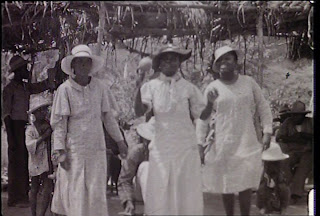
Gage Avril, the editor of this box set, first tipped me off to the Lomax’s footage of rara (which the Lomax Archive was generous and helpful in providing).  When I watched the footage I was immediately struck by the many remarkable paradoxes. The first was that the footage, shot in 1936, is in full color!  (In fact, it became a challenge to convince audiences that the footage was as old as it is.)

The second paradox was that while it was one of the earliest recordings of rara in the field - it was also largely faked.  As I’d learned from Dr. Avrill, the rara was staged for the camera, outside of traditional rara season, and within the confines of a private compound or “lakou.” The problem was that there were no public raras to film, since the local Catholic Church was in the midst of one of its periodic vodou purges, in which public ceremonies were banned, drums and ritual objects were burned, and by some accounts, vodou priests were occasionally killed.   
So the footage didn’t have the usual chaos or a rara procession, where its nearly impossible to figure out what’s going on or where to look..  Instead a few musicians, dancers and singers made few orderly marches and turns, dancing, jumping and flailing arms along the way. (Lomax’s team could record film or audio, but not both at the same time, so it was impossible to tell which songs were actually being played).  Yet ironically, there was something in the staged exuberance of the footage that communicates the spirit of rara better than almost any footage I’d found. It was as if, knowing that the audio wasn’t being recorded, the musicians were giving the camera a silent charade of what rara was supposed to sound like.  When we’d show the footage to audiences in rough-cut screenings, they always love the clips, and comment on its infectious energy.  It ended up being one of the most compelling documents of rara we’d found.
In the end, just as it was impossible to define rara, we realized it was impossible to find footage which could show what a “true” rara looked like.   The best we could do was to look to incredible documents like Lomax’s films for flickering hints about the origins, the meanings, and the spirit of the music which is still moving and electrifying audiences decades later and thousands of miles away.   

Tuesday, September 22, 2009

A Rara Band’s Search For Home Pt. 1

A Rara band’s search for home, a filmmaker’s search for archival footage
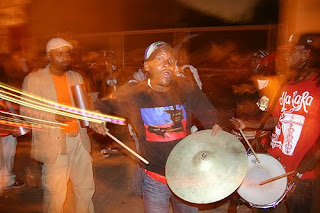
Jeremy Robins, along with Magali Damas, have created an amazing documentary, The Other Side Of The Water, following a group of young immigrants who take an ancient music from the hills of Haiti and reinvent it on the streets of Brooklyn.  Alan Lomax's recordings of the Rara Bands he came upon during his trip in Haiti will be found on Vol. 4 in the upcoming Box Set with film footage as well.  Robins has been kind enough to contribute to our blog (go HERE to see the trailer to his Documentary)...

"I first heard that Alan Lomax’s had shot film in Haiti in the 30’s back in 2005, while I was in the middle of quest to find every scrap of archival footage of the style of Haitian processional music called “rara”.
Along with my co-producer Magali Damas, I was creating the documentary titled “The Other Side of the Water” about the 20-year journey of a rara band in Brooklyn NY.  The project was an attempt to tell the story of the enormous but often hidden Haitian community of Brooklyn, and more broadly to explore of one of those amazing New York subcultures; how it survives, evolves, and relates to its home culture.
One of the biggest challenges in making a film about rara music in America was trying to answer the basic question “What is Rara?”  A percussionist in Prospect Park described it as a walking vodou ceremony; a scholar friend defined it as subtle
 and intelligently coded political and social commentary utilized by Haiti’s disenfranchised poor; the mother of the band’s drummer described rara as a vulgar, drunken, musical mob.
  (My favorite answer is that it’s all of the above, all at once.)  
If we were going to try to establish a working definition of such a complex and contradictory ritual, we would need a lot of strong archival clips.
For our current day footage (over 300 hours of MiniDV and DVCPro tapes), we filmed roughly a year in the life of the rara-band-in-exile, following characters through basement vodou temples, underground economies, and the ground-shaking processions through darkness of Brooklyn’s Prospect Park.  
We also found troves of home-movies shot by the band’s fans since its founding in 1990.  This stack of beat-up VHS and Hi-8 tapes traced the band’s jubilant creation one afternoon after Aristide’s first election, through the
politicization of the band during the “Haitian-American Civil Rights Movement”, through the band’s own internal coup – when young hip-hop inspired musicians arrived from Haiti with a vastly different conception of the music. In each stage, hundreds of years of history, stigma, politics and identity are battled out in the haunting sounds of tin kone horns and bamboo vaksins.  
But there was still the problem of defining rara - and more specifically finding footage that could bring its origins to life ......."