Showing posts with label Alan Lomax. Show all posts

Wednesday, October 28, 2009

ALAN'S REPORT TO THE LIBRARIAN OF CONGRESS

On December 21st, 1936, Alan Lomax sent a report to Herbert Putnam, the Librarian Of Congress, about his first impressions after arriving in Haiti.  This quote is published here for the first time...

"I have looked about enough to be sure this is the richest and most virgin field I have ever worked in. I hear fifteen or twenty different street cries from my hotel window each morning while I dress. The men sing satirical ballads as they load coffee on the docks. Among the upper-class families many of the old French ballads have been preserved. The meringue, the popular dance of polite society here, is quite unknown in America and has its roots in the intermingling of the Spanish and French folk-traditions. The orchestras of the peasants play marches, bals, blues, meringues. Then mama and papa and kata tambours officiate at as many kinds of dances ⎯ the congo, the Vodou, and the mascaron. Then there seem to be innumerable cante-fables [oral tales punctuated by songs or rhymes performed by the audience]. Each of these categories comprise, so I am informed, literally hundreds of melodies ⎯ French, Spanish, African, mixtures of the three. The radio and the sound movie and the phonograph record have made practically no cultural impression, so far as I can discover, except among the petit-bourgeois of the coastal cities. And American jazz is hardly known here except among the rich who have visited America. Composition, by which I mean folk composition, is still very active. So I think I can say that unless a piece of sky falls on my head, this trip will mean some beautiful records for the Library’s collection."

Monday, October 26, 2009

THE HAITI BOX SET - FREE TASTE #3

As a former French colony, Haiti inherited the European celebration called Carnaval, which emerged in medieval times as a period of excessive indulgence before the abstinence of Lent. Coming in the dead of winter as a harbinger of spring, Carnaval celebrates eating, drinking, dressing in costume, and all forms of transformation, transgression, playful obscenity and humor. (including political humor, piking fun at the church and state and the heirarchy of social relations)


Click on the text box below to enjoy the music of Carnaval:
(please be patient...this email widget can take a few moments to load on certain platforms)

Wednesday, October 7, 2009

A Rara Band’s Search For Home Pt. 2

...but there was still the problem of defining rara - and more specifically finding footage that could bring its origins to life. A year and a half of archival research had provided some clues: Maya Deren’s Divine Horseman includes some gorgeous shots of rara dancing and vaksin playing.  Anthropologists George Eastman Simpson and Melville and Francis Herskovitz documented both a few stunning processions, as well as many of the rites and rituals of village life from which the ritual or rara sprang.  Other leads were more elusive: we heard a rumor from a scholar that Katherine Dunham had filmed rara’s in her graduate studies research. 

After a year and a half of emails, phone calls and written requests, we were finally given access to the footage only to discovered that 1) while Dunham was a genius at writing, dance, and scholarship, she wasn’t particularly gifted at holding a camera steady, and 2) she did not in fact ever film more than a few seconds of barely-on-screen rara musicians.  

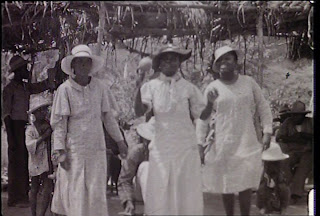
Gage Avril, the editor of this box set, first tipped me off to the Lomax’s footage of rara (which the Lomax Archive was generous and helpful in providing).  When I watched the footage I was immediately struck by the many remarkable paradoxes. The first was that the footage, shot in 1936, is in full color!  (In fact, it became a challenge to convince audiences that the footage was as old as it is.)

The second paradox was that while it was one of the earliest recordings of rara in the field - it was also largely faked.  As I’d learned from Dr. Avrill, the rara was staged for the camera, outside of traditional rara season, and within the confines of a private compound or “lakou.” The problem was that there were no public raras to film, since the local Catholic Church was in the midst of one of its periodic vodou purges, in which public ceremonies were banned, drums and ritual objects were burned, and by some accounts, vodou priests were occasionally killed.   
So the footage didn’t have the usual chaos or a rara procession, where its nearly impossible to figure out what’s going on or where to look..  Instead a few musicians, dancers and singers made few orderly marches and turns, dancing, jumping and flailing arms along the way. (Lomax’s team could record film or audio, but not both at the same time, so it was impossible to tell which songs were actually being played).  Yet ironically, there was something in the staged exuberance of the footage that communicates the spirit of rara better than almost any footage I’d found. It was as if, knowing that the audio wasn’t being recorded, the musicians were giving the camera a silent charade of what rara was supposed to sound like.  When we’d show the footage to audiences in rough-cut screenings, they always love the clips, and comment on its infectious energy.  It ended up being one of the most compelling documents of rara we’d found.
In the end, just as it was impossible to define rara, we realized it was impossible to find footage which could show what a “true” rara looked like.   The best we could do was to look to incredible documents like Lomax’s films for flickering hints about the origins, the meanings, and the spirit of the music which is still moving and electrifying audiences decades later and thousands of miles away.   
Tuesday, September 22, 2009

A Rara Band’s Search For Home Pt. 1

A Rara band’s search for home, a filmmaker’s search for archival footage
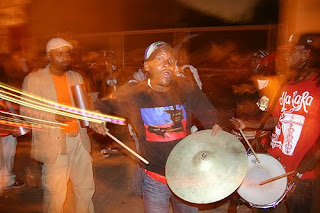
Jeremy Robins, along with Magali Damas, have created an amazing documentary, The Other Side Of The Water, following a group of young immigrants who take an ancient music from the hills of Haiti and reinvent it on the streets of Brooklyn.  Alan Lomax's recordings of the Rara Bands he came upon during his trip in Haiti will be found on Vol. 4 in the upcoming Box Set with film footage as well.  Robins has been kind enough to contribute to our blog (go HERE to see the trailer to his Documentary)...

"I first heard that Alan Lomax’s had shot film in Haiti in the 30’s back in 2005, while I was in the middle of quest to find every scrap of archival footage of the style of Haitian processional music called “rara”.
Along with my co-producer Magali Damas, I was creating the documentary titled “The Other Side of the Water” about the 20-year journey of a rara band in Brooklyn NY.  The project was an attempt to tell the story of the enormous but often hidden Haitian community of Brooklyn, and more broadly to explore of one of those amazing New York subcultures; how it survives, evolves, and relates to its home culture.
One of the biggest challenges in making a film about rara music in America was trying to answer the basic question “What is Rara?”  A percussionist in Prospect Park described it as a walking vodou ceremony; a scholar friend defined it as subtle
 and intelligently coded political and social commentary utilized by Haiti’s disenfranchised poor; the mother of the band’s drummer described rara as a vulgar, drunken, musical mob.
  (My favorite answer is that it’s all of the above, all at once.)  
If we were going to try to establish a working definition of such a complex and contradictory ritual, we would need a lot of strong archival clips.
For our current day footage (over 300 hours of MiniDV and DVCPro tapes), we filmed roughly a year in the life of the rara-band-in-exile, following characters through basement vodou temples, underground economies, and the ground-shaking processions through darkness of Brooklyn’s Prospect Park.  
We also found troves of home-movies shot by the band’s fans since its founding in 1990.  This stack of beat-up VHS and Hi-8 tapes traced the band’s jubilant creation one afternoon after Aristide’s first election, through the
politicization of the band during the “Haitian-American Civil Rights Movement”, through the band’s own internal coup – when young hip-hop inspired musicians arrived from Haiti with a vastly different conception of the music. In each stage, hundreds of years of history, stigma, politics and identity are battled out in the haunting sounds of tin kone horns and bamboo vaksins.  
But there was still the problem of defining rara - and more specifically finding footage that could bring its origins to life ......."

Monday, September 14, 2009

A Vodou Ceremony Pt. 2

A Vodou Ceremony Pt. 2

Possession by the Loi


...then a violent and frenzied dance begins — the hips and shoulders shaking, wiggling, shivering, and vibrating in a fashion impossible for a person in a normal physical state. Later Gran Erzulie enters into the body of a young girl who had seemed before to be made out of sections of willow branches; a completely soft young adolescent face over a body so pliant and fine that it could not stand straight but let every bone take its own separate angle, the whole body akimbo. 

Now this pliant body grew suddenly old, the legs were bent and bowed inward with rheumatism and the belly was sucked up with pain and fatigue under the withered breast. A continual low murmur of groans and whines came from the twisted lips as the other dancers jostled her.

Then the drummer, Ciceron [Marseille], whom I believe carries all the loi in his thin, old hunched shoulders that make the mama drum growl and roar, called to the loi to dance, and Simbi and Gran Erzulie seemed to be shaking themselves to pieces, the first in his male and the second in her old female fashion. This dance went on growing more and more violent until the mamaloi called for a mason, which is the signal for the departure of spirits. At the end of this dance, both Simbi and Gran Erzulie swooned separately on the floor in each others’ arms, those two young bodies curved against one another in a sort of trance of exhaustion. All this time, of course, there had been other loi in the women present, but the loi themselves, the inspired women, had given place way and precedence to the two I have described. Presently, as the singing recommenced, the body that had held Simbi dragged itself off into a corner and went to sleep with its head in its arms The habitation of Gran Erzulie, however, only leaned against the wall for a few moments and soon was back in the dance again.

Monday, August 31, 2009

A VODOU CEREMONY Pt. 1

While Alan Lomax was in Haiti he kept a very detailed journal of his travels, recordings, findings and feelings.  The journal will be transcribed as its own book in the upcoming boxset ALAN LOMAX IN HAITI, due out in November on Harte Recordings.  It was transcribed by his niece, Ellen Harold.  For the first time ever, the public will be able to read his journal. The following is the first part of his description of a vodou ceremony...

A Vodou Ceremony Pt. 1
Possession by the Loi

The Mombo and her assistant were in no hurry about lighting the candles on the altar from the oil lamp that is kept burning always on the floor of the assembly room. The doors were kept shut, or partially so, during the lighting of the candles, in one of which four young women who are being prepared for baptism participated.
At last, however, the Mombo began to dance. She whirled slowly about the rooms a few times, swaying and bowing, her feet as precise as a première ballerina. She made libation before each drum. Presently, after she had danced for ten minutes, and she is by far the most graceful and charming dancer I had so far seen, the others began. Each one in turn kissed the ground before the drums, the others singing, the drums beating the Jean Valou rhythm, and then bowed and kissed the ground before the Mombo's feet. 
There was the usual stately and warm handshaking, curtseying, twirling, and embrasse-ing. A few of us went into the chapel room on the left side and kissed the ground before the three candles before the altar, touching first our hearts and then the earth with our index fingers. A kiss before another candle on the ground at the right wall, and before a square basin of water at the rear (this is Damballa).
Back in the main room again the drums were beginning to pull the loi into the hearts of the worshippers. A tall young woman in white with a red head rag and a loose and silly face was Simbi. A possessed person (generally) begins by staggering about the room on one leg, almost but never quite falling into the arms of the spectators. The motion is that of a person walking along the iron of a railroad track. Then a violent and frenzied dance begins....(to be continued)

Wednesday, August 5, 2009

Tracking Through Haiti: The 1937 Lomax Recordings in a New Millennium

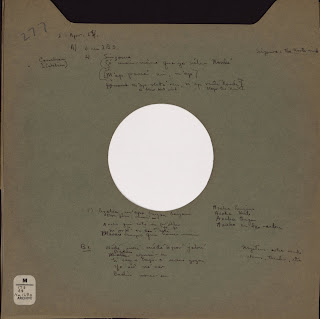
The following post is from Matthew Barton, the Curator of Recorded Sound at the Library Of Congress at the National Audio Visual Center in Virginia.  Here he discusses the discs used by Alan and Elizabeth Lomax to record the sounds and music they experienced on their Haitian journey....

One interesting aspect of the experience was that since the discs were copied in the order they were recorded, the whole field trip was relived, in a sense.

In one of the first recordings from this field trip, Alan Lomax can be heard expressing his doubts about his recording apparatus during a microphone test conducted somewhere in Port au Prince, Haiti. I heard his remarks on the first of some 300 aluminum discs that Library of Congress sound engineer Brad McCoy transferred digitally while I took notes from the other side of the turntable for nearly a month several years ago. The aluminum disc system employed for these Haitian recordings was indeed cumbersome and difficult, and this would be the last major field trip on which Alan employed it, switching soon thereafter to the new portable acetate disc cutters that made quieter and more sensitive recordings.   

Clumsy as the old system was, Alan and Elizabeth Lomax had nevertheless made it work in an astounding array of unusual recording situations in the days from Christmas, 1936 through Easter, 1937 in Haiti.  From lone singers to full dance orchestras; from the more polite steps of Port au Prince society to the high-energy rhythms of Mardi Gras drummers; from church services to voodoo ceremonies, they pushed the equipment to the limit. The twelve-inch aluminum discs they used for most of these recordings could only hold about five minutes of sound comfortably, but often, they simply had to hold more. On many discs, Brad and I saw that they had allowed the recording head to keep tracking to within barely an inch of the hole in the center of the disc. This reduced the fidelity and created untold technical headaches more than sixty years after the recordings were made, but in this way, a few seconds, perhaps even a full minute more of priceless documentary recording was accomplished

For more than seventy years, these recordings have lain in obscurity. I doubt if even a single scholar has listened to them all. They are not the only field recordings to have languished for decades, but I wonder if any field recording trip of this scope and importance ever sat on the shelf for so long. The recordings had little or no direct effect in their day, but they at least set a precedent and may have helped facilitate other important fieldwork undertaken for the Library of Congress over the next several years, including Melville and Francis Herskovits’s Brazilian recordings and Henrietta Yurchenco’s Mexican recordings. Now at last, they can reach Haiti and the rest of the world, and I’m very glad to no longer be one of the only people to have heard these precious discs.  

**The image in this post is of a disc sleeve of one of Alan's recordings including his notes.


Saturday, July 11, 2009

Haiti Trip Ephemera Pt. 1

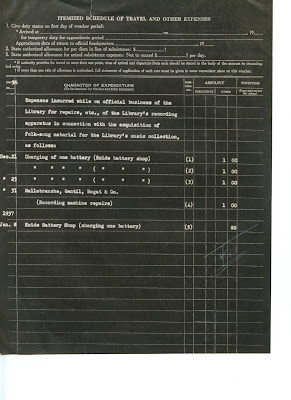
From the vaults of the Library Of Congress comes this interesting piece: a carbon copy of one of Alan Lomax's expense sheets regarding the Haiti trip. 
....there are more items like this one to come!